What the Kona Name Is Asking
November 4, 2026
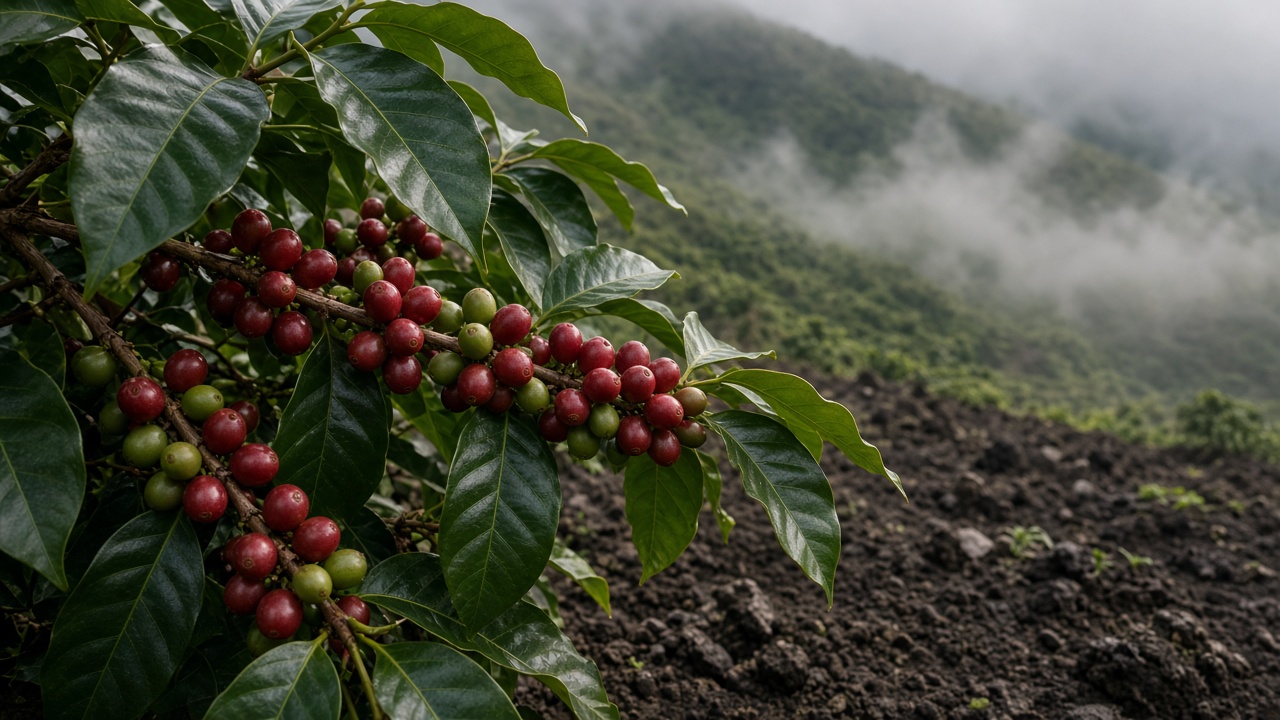
I have not stood in the North Kona district or the South Kona district. I want that said before the mist gets into the sentence. The photograph at the top of this page is a made picture of coffee fruit on a slope, credited as generated, and it is not a photograph I took on Hawaiʻi Island. What I have stood in front of is a bag, in an ordinary shop, with the word Kona printed larger than anything else on the paper. The word does what a far place always does to a tired morning. It offers a landscape in exchange for attention. I wanted the landscape. Then I wanted to know what the word is legally allowed to mean.
Hawaiʻi defines it. Section 708-871.5 of the Hawaii Revised Statutes, the false-labeling law, says Kona is the North Kona and South Kona districts on the island of Hawaiʻi, as the state's tax map draws them. The same section defines the other names a bag might borrow: Hāmākua, Kaʻū, Kauaʻi, Maui, Molokaʻi, Oʻahu, and Hawaiʻi itself. Cherry coffee, in that statute, is the unprocessed fruit. Green coffee is the commodity of green beans. Parchment is what remains after the seeds are taken out of the pulp and dried. Roasted coffee is what heat does to those seeds so that aroma and flavor come forward. I am quoting the statute's own distinctions because the romance of a cherry on a branch is real, and so is the distance between that fruit and the word on a roasted bag.
The labeling rule that sits beside the criminal law is section 486-120.6. For a roasted coffee, an instant coffee, or a ready-to-drink coffee that is one hundred percent Hawaiʻi-grown and Hawaiʻi-processed, from a single geographic origin, the identity statement is that origin followed by the word Coffee. The term 100% may sit immediately in front of the origin. So "Kona Coffee" and "100% Kona Coffee" are the straight claims. They are straight only if the package contains one hundred percent coffee by weight from that one place. Using that kind of statement, or similar terms, when the coffee is not entirely from that origin is a violation. I had been reading "Kona" as a mood. The statute reads it as a weight.
Blends are allowed, and they have to confess. A blend of Hawaiʻi-grown coffee with coffee from elsewhere uses the percent by weight of one of the Hawaiʻi coffees, then the origin, then the words Coffee Blend. A second line begins with Contains: and lists the other origins in descending order of weight, each with its percent, or it may gather the non-Hawaiʻi coffee under the words Foreign-grown Coffee and a percent. The Hawaii Department of Agriculture's Measurement Standards Branch, in its August 2024 guideline, says those percents have to add to a hundred, and it shows the kinds of lines that fail. "Pure" stuck inside "100% Pure Kona Coffee" is intervening material. "Peaberry" stuck inside the identity statement is intervening material. "Kona Blend" without the word Coffee in the required place fails. A bare "Kona Coffee" on a blend fails because those two words imply the one-hundred-percent claim. The guideline is a guideline, and it says so. The statute is the statute. Together they make a simple demand of me as a buyer: read the identity line, not the photograph of the farm.
There is a date in the statute I keep returning to. Until June 30, 2027, a roasted coffee, instant coffee, or ready-to-drink coffee may not use a geographic origin in labeling or advertising if it contains less than ten percent coffee by weight from that origin. On and after July 1, 2027, the floor rises. The origin may not be used if the coffee contains less than fifty-one percent by weight from that place. The Department of Agriculture's market paper of July 24, 2025, tells the longer story of that number. A 1991 law let a regional name appear when only ten percent of the beans came from the region. The paper says the ten-percent Kona blend became a way to sell a taste of the name at a lower point than a pure Kona coffee, and that growers argued the practice deceived buyers and wore the name down. Act 198 of 2024, which the statute now carries, moves the minimum toward fifty-one percent, with compliance required by July 1, 2027. I am not going to tell you whether that change is gentle or rough on a particular roaster. I was not in the hearing. I can tell you what I do at a shelf: if the front of the bag says Kona and the identity line says ten percent, I believe the ten, not the size of the type.
"All Hawaiian" is a different promise. The statute forbids it unless the coffee is produced entirely from green beans grown and processed in Hawaiʻi. The measurement guideline adds that processing includes decaffeination. A coffee decaffeinated somewhere else does not get the phrase, even if every bean was grown in the state. That detail moved me more than I expected. A word can be lost in a warehouse on another coast, after the cherry, after the parchment, after the romance.
False labeling is not a scolding. Under section 708-871.5 it is a class C felony to knowingly transport, distribute, advertise, sell, or possess for sale Hawaiʻi-grown green, cherry, parchment, or roasted coffee that is falsely labeled as to geographic origin. Act 126 of 2025 widened the offense so roasted coffee is inside it, because the legislature found that most of the misrepresentation was happening in roasted products. Act 198 of 2024, which I read in the session laws, states the legislature's reason in plainer language: a ten-percent blend could still wear the region name, the flavor of Kona at that share was often undetectable, and a 2018 study from the Food and Agriculture Organization and the European Bank for Reconstruction and Development had concluded that Kona coffee did not enjoy strong protection of its name, so downstream sellers rather than farmers took the benefit of the fame. The act's remedy is the fifty-one percent floor, effective July 1, 2027. Retailers who do not package the coffee are exempt from liability for selling a bag someone else labeled badly. The grower and the roaster are who the rule is watching.
The same July 2025 paper, from the Agricultural Development Division, gives the scale of the crop I was daydreaming about. In the 2023-2024 season, it says, coffee was cultivated on about 1,000 farms across 7,400 acres on five Hawaiian islands, and green coffee production totaled 3.4 million pounds. It also says coffees from Kona, Kaʻū, and Maui consistently score 85 and above on the Specialty Coffee Association cupping scale. The first page says the views are the author's and not necessarily the department's official position. I read it as a briefing, not as a souvenir.
I still want the slope. I want the red fruit and the green fruit on the same branch, and the cloud on the hill, and the feeling that a cup can carry a district. Wanting it is allowed. Inventing that I have walked the rows is not. The honest version of the desire is a habit at the shelf. I look for the word Coffee after the origin. I look for a percent when the bag is a blend. I notice whether "100%" is in front or whether the type is doing the exaggerating. I do not need the mist in order to be loyal to the place. The people who grow the coffee already did the harder work, which was to make the name mean a map instead of a mood.
If I get to those two districts, I hope the morning is ordinary. A road, a farm that is a farm and not a backdrop, fruit at whatever stage the season has actually reached. Until then the cup in my kitchen is allowed to be good without wearing a district it did not earn. And when a bag does wear Kona, I want the law's sentence to be the one I remember: the origin, then the word Coffee, and nothing slipped between them to make the truth prettier than the weight.
Sources
- Hawaii Revised Statutes §708-871.5, False labeling of Hawaii-grown coffee
- Hawaii Revised Statutes §486-120.6, Hawaii-grown coffee labeling
- Hawaii Department of Agriculture, Measurement Standards Branch, General guidelines for labeling roasted Hawaii-grown coffee, August 2024
- Hawaii Department of Agriculture and Biosecurity, Agricultural Development Division, Hawaiʻi's Coffee Production, Exports, and Labeling and Blend Requirements, July 24, 2025
- Act 198, Session Laws of Hawaii 2024