How Roasted Coffee Goes Stale
November 2, 2026
The best smell in a kitchen is often the one that is already leaving. I open a bag because the roast date is recent and the room fills, and a week later the same beans make a cup that is only polite. I wanted the chemistry of that disappointment, not a proverb. The papers I opened do not all agree on a single clock. They agree on the enemies: oxygen, heat, and a package that lets the fragrant parts escape.
A group at the Zurich University of Applied Sciences, reporting at the 2012 coffee-science meeting in San José, tried to measure freshness instead of admiring it. Barbara Schönbächler and her colleagues tracked ratios of aroma compounds by headspace gas chromatography for coffee packed in different materials. Whole beans in packaging that was not airtight had a shelf life they describe as smaller than two months. In airtight packs, most of the ratios they watched did not change in a meaningful way for almost a year. One ratio did change: dimethyl disulfide against methanethiol. They read that shift as the aroma decomposing on its own, methanethiol turning into dimethyl disulfide, and they called it the better reflection of freshness. Capsules in the same work stayed airtight for about forty weeks. I take two lessons and I leave the rest of their method in the paper. A seal matters more than a mood. And even a good seal does not freeze a roast in the week it was born. Something inside the bean keeps rearranging.
The same laboratory's longer look at freshness indices, published in CHIMIA in 2014, follows whole beans in four packaging materials and capsule systems for up to a year. The ratio of 2-butanone to 2-methylfuran is the one they treat as the familiar shelf-life marker. Both compounds are relatively stable chemically. 2-methylfuran is simply very willing to evaporate. If the package lets it go, the ratio climbs, and the climb is about loss through the wall more than about a new reaction. Packaging with an aluminum layer showed only small changes. Packaging without that layer diverged within two weeks. The paper also says the absolute value of an index remembers what happened before the bag was sealed, so a number is not a moral score you can paste onto every roaster. What I can paste onto a cupboard is simpler. A bag with a real barrier holds the volatile fraction. A bag that is only pretty does not.
Heat joins oxygen once the coffee is trying to live for months. A 2025 paper in the Journal of Food Process Engineering, by Kim and colleagues, stored moderately dark roasted beans in aluminum-metallized bags fitted with a pressure-releasing valve, at 15, 25, 35, and 45 degrees Celsius. The beans push out carbon dioxide after roasting. In those bags the headspace, which began as ordinary air, shifted toward a high carbon-dioxide atmosphere, mostly above 0.7 atmospheres of CO2, while oxygen fell to a very small partial pressure. Warmer storage made that shift faster. The authors treat oxidation, measured as a rising peroxide value, as a primary way the coffee goes downhill, and they found that oxidation sped up with temperature in the way chemists expect, with an activation energy they report as 42.5 kilojoules per mole. pH and titratable acidity barely moved except late and at the hottest condition. I am not asking anyone to store coffee at 45 degrees and call it a test. I am asking what the kitchen already knows and rarely admits. The cabinet over the oven is a different climate from a cool shelf. The valve on a fresh bag is not a decoration. It lets the carbon dioxide out so the bag does not balloon, and in the study that exit was part of how the inside of the package became a low-oxygen room. Once you cut the bag open, you have dismissed that room. The study is about sealed packages. Opening is a second life, and it is less protected.
What I do with an open bag has fewer peer-reviewed comforts, so I will stay with what these papers make reasonable. Keep the beans whole. The CHIMIA work and the Zurich conference paper are about whole beans, and grinding multiplies the surface that oxygen and evaporation can use. Keep them airtight after the seal you bought has been broken. The Zurich result is blunt about non-airtight storage: on the order of less than two months, against nearly a year when the pack holds. Keep them cool, because Kim's peroxide values rose faster as the temperature rose. Keep them in the dark only because light and heat often arrive together on a counter; the papers I am leaning on indict oxygen loss and temperature more directly than they indict a lamp. I am not going to tell you to freeze the jar. I did not open a freezing study I am willing to lean on. I am not going to tell you the refrigerator is a sin. I will say a warm place is a faster place, and that a sealed barrier did more in these papers than hope did.
There is also a clock that starts at the roaster, before your cupboard gets a vote. Lavazza's espresso guide tells a home barista to use beans between 7 and 21 days after roasting: too fresh and the puck is unstable, too old and the crema collapses. The guide's note on thin crema blames coffee past about four to six weeks from the roast, along with low temperature, low pressure, or a coarse grind. Breville's Dual Boiler manual, in the troubleshooting for a fast shot and a gauge that will not reach 9 bars, says to use freshly roasted beans with a roasted-on date and to consume them between 5 and 20 days after that date. Those two ranges are advice from a coffee company and a machine manual, not a single laboratory law. They sit next to the packaging science without replacing it. A perfect jar will not rescue a roast that has already exhaled its 2-methylfuran through a thin bag in a hot warehouse. A terrible jar will waste the week the roaster and the manual both think is the good one.
Degassing belongs in the same picture. Kim's bags filled themselves with carbon dioxide from the beans and thereby crowded the oxygen down. That gas is the reason a very fresh puck can misbehave, which is Lavazza's "too fresh" problem, and it is the reason a valve exists. When the gas is gone and the oxygen has had its turn, you are left with a bean that still looks like coffee and smells like a memory of coffee. Schönbächler's group would say some of that fading is intrinsic, the methanethiol converting even inside a decent pack. The rest is a leak you could have refused.
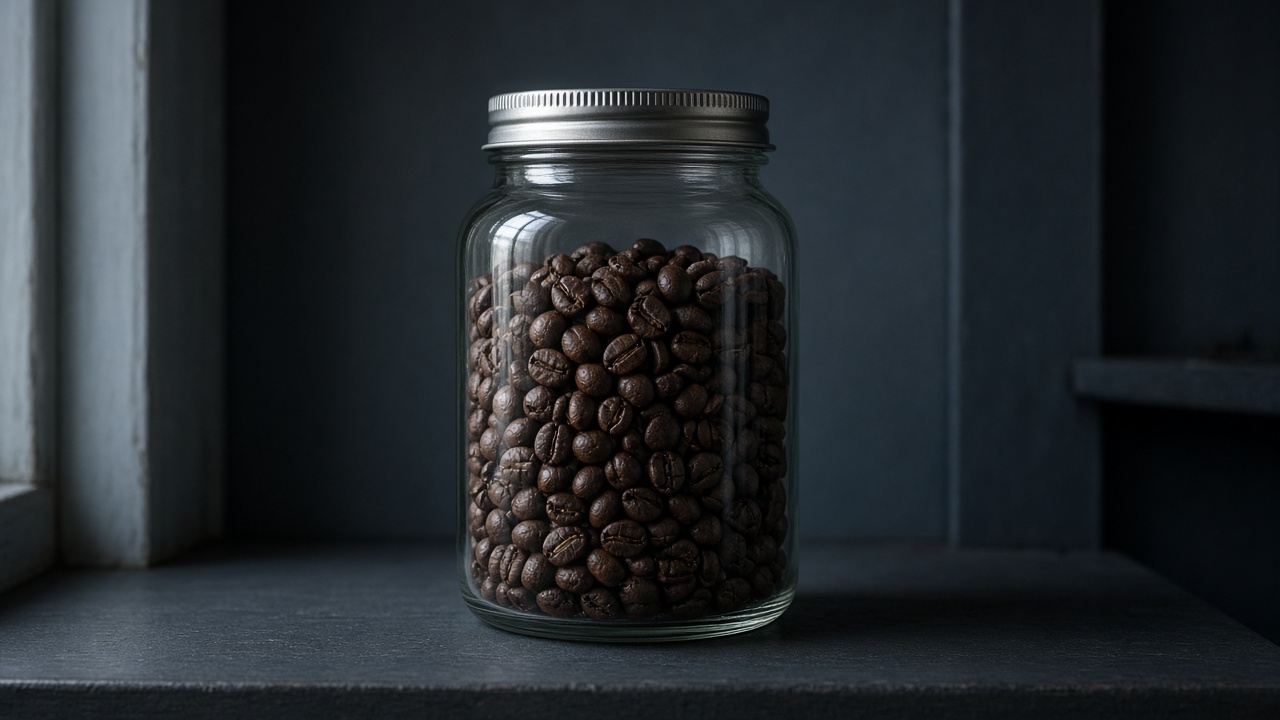
My own practice, stated as practice and not as a finding, is a jar with a gasket, filled from a bag I buy in amounts I will actually brew, kept off the stove and out of the sun. I write the roast date on a piece of tape because the bag's date is easy to lose and because both the manual and the guide think the date matters. I do not grind the week's coffee on Sunday. Lavazza is as strict about that as about the machine: ground coffee gives up carbon dioxide and volatile aromatics quickly, and the guide calls the difference between fresh grinding and pre-ground anything but subtle. The Zurich and CHIMIA papers were not written to flatter a ritual. They were written to see whether a package can hold a ratio still. The ritual is just the part I can do with my hands.
If the cup has gone dull, I no longer start by blaming the water or my mood. I ask how old the roast is, whether the bag had a barrier, whether it has been open, and whether the shelf is warm. Those questions are the whole science, translated. The bean is a small pressurized aromatic thing that wants to become ordinary air. Storage is the delay.
Sources
- Schönbächler and colleagues, Can we measure the freshness of roasted coffee?, Zurich University of Applied Sciences, ASIC 2012
- Glöss and colleagues, Freshness Indices of Roasted Coffee, CHIMIA 2014
- Kim and colleagues, Storage Temperature Effect on Roasted Coffee in a Valve Bag, Journal of Food Process Engineering, 2025
- Lavazza, How to make an espresso the Italian way
- Breville, the Dual Boiler Instruction Book, BES920