What a Home Espresso Machine Is For
November 2, 2026
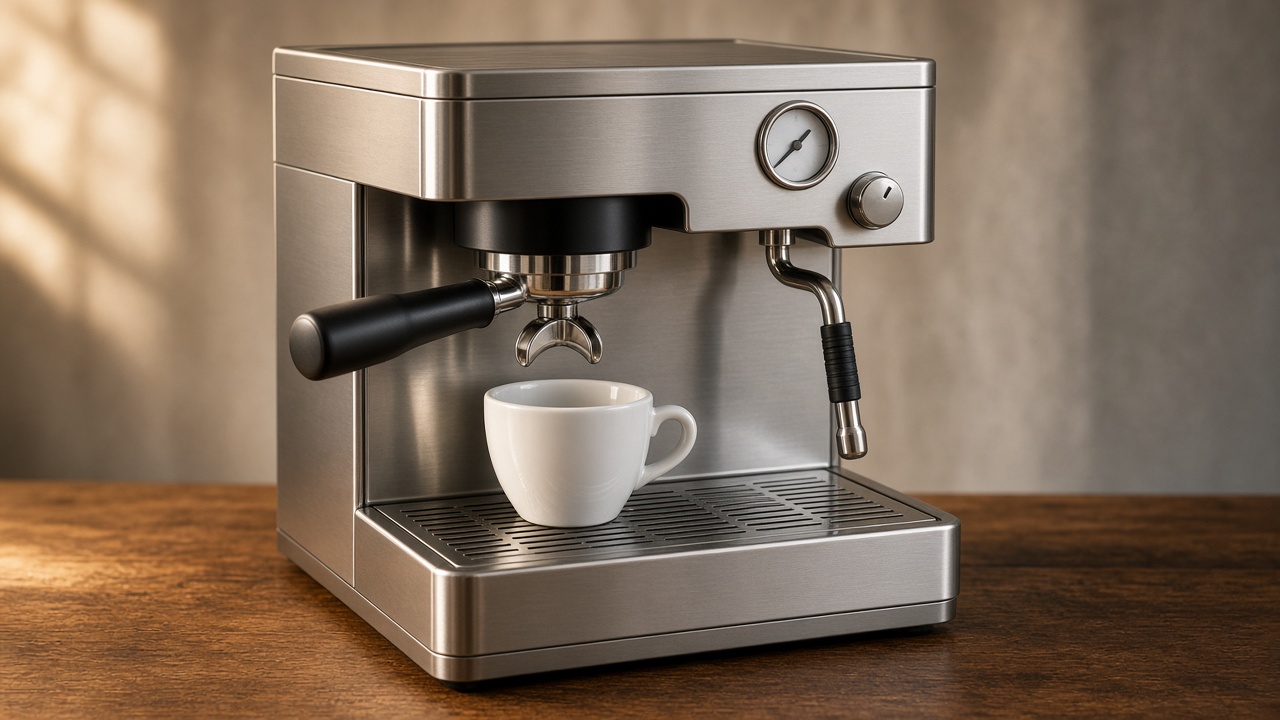
I have not scored a row of machines on my own counter, and I am not going to invent a winner. This is a review of the job. A home espresso machine has one job that matters and a second job that complicates it. The first is to push hot water through a puck of fine coffee at a steady pressure and a steady temperature. The second, if you want milk drinks, is to make steam hot enough to texture milk, ideally without wrecking the water you just used for the shot. Everything in a spec sheet is a way of saying how a particular box attempts those two jobs.
The Specialty Coffee Association still prints the older Specialty Coffee Association of America definition, in David Fasman's account of a 2017 barista survey for 25 Magazine. Espresso, in that heritage line, is a 25 to 35 milliliter drink from 7 to 9 grams of coffee, twice that for a double, made with clean water at 195 to 205 degrees Fahrenheit forced through at 9 to 10 atmospheres, ground so the shot runs 20 to 30 seconds, with a flow like warm honey and a thick dark golden crema, prepared for the person who is about to drink it. Fasman and the Barista Guild then asked what people were actually doing. Two hundred seventy-five baristas answered, about three-quarters of them in the United States. Ninety-three percent called their usual extraction a double. Most put the dose between 18 and 20 grams. Eighty-two percent measured the yield by weight, and the average yield they reported was 36.5 grams. The average ratio was 1 to 2, inside a range from 1 to 1.5 through 1 to 2.5. Average pressure was 8.5 bars, and the single most common answer was 9. A bit over half used pre-infusion. Temperature answers sat in the old 195 to 205 degree band, with an average of 200.3. Most used an 18 gram basket. The survey is not a law. It is a photograph of practice, and it is the photograph I trust when a product page starts inventing a private standard.
Lavazza's home guide aims at the same neighborhood and adds a warning I wish every pump advertisement would print. The target pressure is 9 bar. The guide says the SCA's definition is water at 9 to 10 bar, 195 to 205 degrees, in 20 to 30 seconds. It also says that below 7 bar the extraction is incomplete, and that above 10 the shot turns harsh. Then the useful sentence: consumer machines advertised with 15-bar pumps typically use a pressure-reducing valve so that what reaches the coffee is 9 bar. The 15 is a description of the pump, not of the puck. I cannot see the valve in a photograph of a pretty group head. I can ask whether the manual mentions an over-pressure valve, a pressure gauge, or a brew pressure the machine is actually trying to hold.
Temperature is where the machines diverge. Prima Coffee's glossary describes the architectures without ranking them. A single-boiler, dual-use machine has one closed boiler for brewing and for steam. Brewing wants the classic band. Steam wants water hot enough to make vapor. One boiler cannot be both at once, so you brew and wait, or steam and wait. The wait is the design. A heat-exchanger keeps one boiler at steam temperature and runs brew water through a tube that crosses it, so you can brew and steam together. Water that idles in the tube overheats, which is why the glossary says these machines are flushed before a shot. A dual-boiler machine gives brew water and steam separate boilers. Prima notes that a PID controller often lets you set those temperatures instead of trusting a single thermostat. The question for any of them is where brew temperature is decided, and whether steam can happen without abandoning it.
Breville's instruction book for the Dual Boiler, model BES920, is one manual I opened, and I am treating it as an example of the dual-boiler answer, not as a champion. The features page says it has dual stainless-steel boilers, one for espresso and one for steam, so milk texturing and extraction can happen together at the temperatures each wants. The group head is described as a commercial 58 millimeter group with its own heating element. Temperature is electronic PID and programmable. An over-pressure valve limits maximum pressure. Low-pressure pre-infusion can come first, and it is programmable. There are two pumps, one described as serving the espresso boiler and one the steam boiler. A gauge monitors extraction pressure. The steam boiler is given as 32 fluid ounces, 950 milliliters. The portafilter is 58 millimeter stainless steel. In the troubleshooting table, a shot that runs too fast is tied to a gauge that is not reaching 9 bars, and the manual's checks are the familiar ones: finer grind, more coffee, a firmer tamp, fresher beans. None of that is a taste test I performed. It is the manufacturer telling you what it built and what it thinks the gauge should approach.
The recipe those parts are trying to serve is no longer the tiny single of the heritage definition. Baratza's dial-in guide, written for people adjusting a grinder against a machine, offers a simple known recipe: 18 grams of ground coffee, 36 grams of liquid, 25 to 32 seconds. Lavazza's guide uses the same 18 in and 36 out, calls the ratio 1 to 2, and suggests 25 to 30 seconds and group-head water between 198 and 202 degrees, with a long warm-up if the machine cannot show you the temperature. Both guides say to change one thing at a time. A machine helps when it can repeat itself: same pressure, same temperature, a clock or a scale you trust, a basket that holds the dose you chose. It does not help when the advertisement's largest number is the pump's theoretical maximum and the manual never says what the coffee feels.
The questions I take to a manual are short. Can brew water and steam be hot together, or is the wait the design? Does a gauge show the pressure at the puck, near the 9 bars the BES920 troubleshooting table expects, or does the brochure only boast about the pump? Does the manual name the basket, the way that book names 58 millimeters? Does it explain pre-infusion, which half the 2017 respondents were already using, and can you skip it when you are only rinsing? Can you stop a shot and weigh it, the way Fasman's baristas were mostly weighing yield? A timer you may interrupt is still in that tradition. A sealed capsule is a different promise. The page should say which promise it is making.
I keep coming back to the person the heritage definition remembers: the coffee is prepared for someone who is there. A home machine earns its place on the counter when it can do that twice in a row on a Tuesday, with the temperature it claims and the pressure the coffee can use. The rest is furniture.