Caffeine in the Cup, and a Clean Machine
November 4, 2026
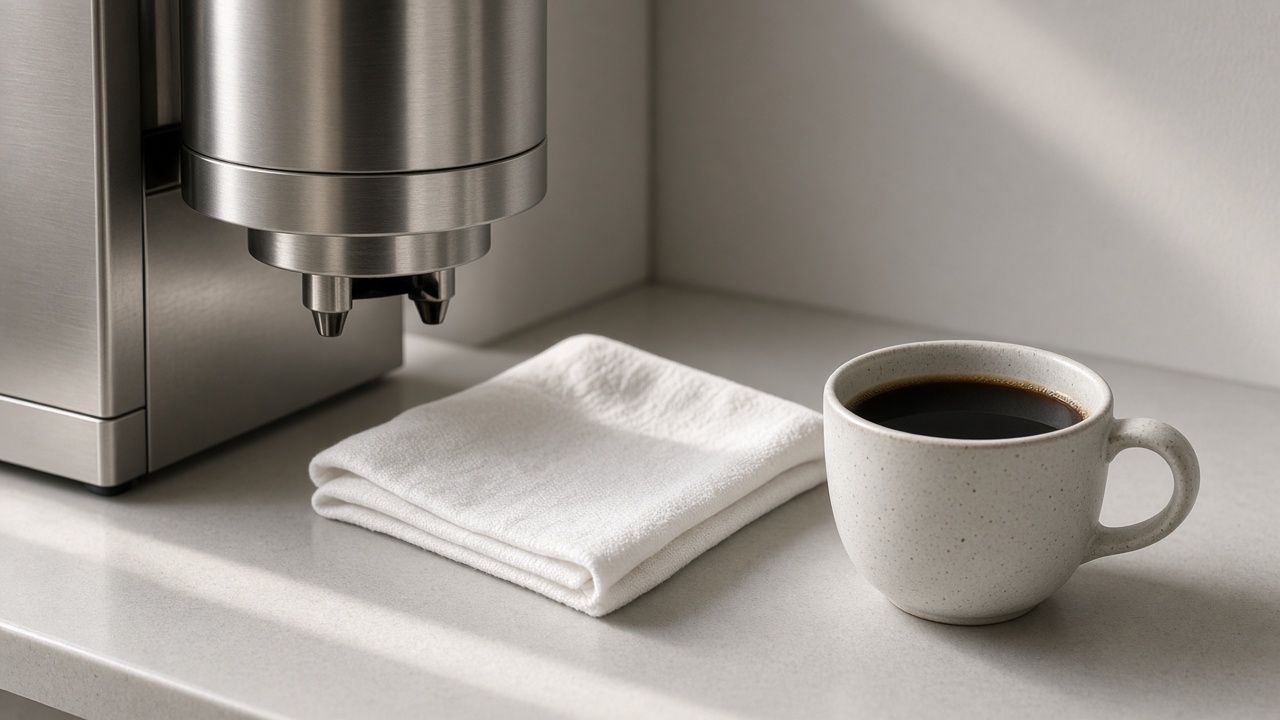
This page is not medical advice. It does not say coffee will treat, prevent, or cause a disease. It says what a few public authorities have published about how much caffeine is in ordinary coffee, and then it says how two manufacturers tell you to clean the machine that made the cup. If you are pregnant, trying to become pregnant, breastfeeding, giving coffee to a child, or worried about a medicine or a condition, the Food and Drug Administration's own sentence is the one to follow: talk with a health care provider. Do not take a number from a journal as a personal limit.
The FDA's consumer update, "Spilling the Beans," says that for most adults the agency has cited 400 milligrams a day, about two to three 12-fluid-ounce cups of coffee, as an amount not generally associated with negative effects. In the same breath it says people differ widely in how sensitive they are and in how fast they clear caffeine, and that some conditions and some medications make the effects stronger. The National Coffee Association's answer to "how much caffeine is in a cup" repeats the FDA's band and then says health guidelines around the world generally conclude that two or three 12-ounce cups, about 400 milligrams, can be part of healthy diets. I am quoting that conclusion, not adopting it as an instruction. The same NCA page tells readers to watch how their own bodies respond and to ask a clinician what is right for them. That is the whole health claim this Journal is willing to print: the agencies said a number, and they also said the number is not a personality.
Inside the FDA's table, a 12-fluid-ounce serving of regular brewed, non-specialty coffee is listed at 113 to 247 milligrams. The agency says those figures are adapted from a 2015 paper in Food and Chemical Toxicology. The width of the range is the fact I care about. Two cups that look alike can differ by more than double. Green tea in the same table is 37 milligrams per 12 fluid ounces, black tea 71, a caffeinated soft drink somewhere from 23 to 83. Decaffeinated coffee, the FDA says, is not caffeine-free. A typical decaf holds 2 to 15 milligrams in an 8-fluid-ounce cup. The update also says the body does not distinguish caffeine that grew in the bean from caffeine that was added to some other product, so the cup is only one line in a day that may include tea, chocolate, soda, and a pill. Restaurants are not required to tell you the milligrams. The FDA suggests you ask.
The Department of Agriculture's FoodData Central gives a different cut of the same drink, and I opened the records rather than a roundup. Brewed coffee prepared with tap water, FDC 171890, published April 1, 2019, is listed at 40 milligrams of caffeine per 100 grams. The footnote says the record includes fast food and home-brewed coffee. Restaurant-prepared espresso, FDC 171891, same publication date, is listed at 212 milligrams per 100 grams. Those are concentrations, not a promise about your mug. A larger cup of the weaker drink can carry as much caffeine as a small cup of the stronger one, which is why "espresso is stronger" and "espresso has more caffeine" are different sentences. Mayo Clinic's chart, dated February 6, 2025, puts the household versions in serving sizes: brewed coffee, 8 ounces, 96 milligrams; brewed decaf, 8 ounces, 1 milligram; espresso, 1 ounce, 63 milligrams; decaf espresso, 1 ounce, 1 milligram; instant, 8 ounces, 62 milligrams; instant decaf, 8 ounces, 2 milligrams. Mayo says the caffeine in a cup varies with how the coffee was grown and how long it was brewed, and it says experts put a possible upper figure for most adults at 400 milligrams, with the same caution about pregnancy and about symptoms such as headache or restlessness. Mayo's decaf brewed figure, 1 milligram, and the FDA's 2 to 15 milligrams are not a contradiction I can smooth over. They are two published descriptions of a drink that is "less caffeine," not "none."
A 12-ounce brew at the low end of the FDA band is a different object from one at the high end. Espresso's 212 milligrams per 100 grams describes a concentration, and the serving is small. Notice the serving, the brew, and the rest of the day. Leave the diagnosis to someone licensed to give one.
The second half of the cup is housekeeping. Coffee oils and mineral scale are different dirt, and Breville's support article on espresso-machine care says so in the first note. A cleaning cycle removes oils and residue from the coffee path. Descaling removes mineral buildup from the water system. Cleaning tablets are not a descaler. The article's order of work is ordinary and worth copying into any kitchen: purge and wipe the steam wand right after milk, run the cleaning cycle when the machine asks or when its manual says, descale with the descaler the manual names, and, if the machine has a grinder, clean the burrs and the outlet on the schedule in that same manual. Continued scale, a related Breville note says, can damage the machine. I am not expanding that into a horror story. I am repeating the distinction, because people ruin boilers by being enthusiastic with the wrong chemical.
The Dual Boiler manual, BES920, is specific where the support article is general, and the steps belong to that model. After a session it wants a clear-water backflush before you turn the machine off. The cleaning disc goes into the filter basket, the portafilter locks into the group, you press the 2 Cup button, you let pressure build for about 20 seconds, you stop and release, and you repeat the whole motion five times, to push fines and oils out of the brew path. A deeper clean arrives when the screen says CLEAN ME, which the manual places at about 200 shots. Then it is the 1 Cup basket, the cleaning disc, one cleaning tablet, a full tank, an empty drip tray, and the menu path to CLEAN CYCLE. The countdown it describes starts at 370 seconds. If the tablet has not dissolved, you run it again without a second tablet, then you rinse the portafilter so the next shot is coffee and not detergent. Descale, on the same machine, is a different afternoon: the manual asks for about an hour and a half, and it wants the machine off and cool for at least an hour first. You are in the menu's descale mode, you empty boilers through the access screws, you fill with the descaler and water, you flush with clean water afterward. I am not going to turn those screws into a universal recipe. If your machine is not this one, its screws are not these screws. The principle that travels is the manual's, and the support article's: oils on one schedule, minerals on another, and the chemical matched to the dirt.
Lavazza's guide, written from the coffee rather than from a particular chassis, is harsher about delay. After every shot, knock out the puck, rinse the basket, wipe it dry. Oils go rancid and flavor the next cup with the stale one. The guide suggests a water backflush of the group weekly and a dedicated espresso cleaner monthly. That monthly tablet and Breville's 200-shot prompt will not land on the same morning for every household. They do not need to. Both sources are telling you that a group head is a place where coffee remains, and remaining coffee becomes the wrong coffee.
Milk dries inside a steam wand. Breville's support steps say to wipe the wand with a damp cloth immediately and to purge it so the milk inside is blown out. The next pitcher should taste like milk and coffee. The same habit covers the shower screen and the basket.
None of this requires a product sermon and none of it requires a price. It requires the page in the book that came with the machine, read once while the machine is cold, and the FDA's table, read as a table. The cup can be a pleasure. The milligrams can be a fact. The cloth can be a habit. Those three things are enough.
Sources
- U.S. Food and Drug Administration, Spilling the Beans: How Much Caffeine is Too Much?
- USDA FoodData Central, brewed coffee, FDC 171890, via the public API
- USDA FoodData Central, restaurant espresso, FDC 171891, via the public API
- Mayo Clinic, Caffeine content for coffee, tea, soda and more
- National Coffee Association, How much caffeine is in a cup of coffee?
- Breville Support, espresso machine cleaning and descaling
- Breville, the Dual Boiler Instruction Book, BES920
- Lavazza, How to make an espresso the Italian way