Burrs, and the Size of a Particle
November 4, 2026
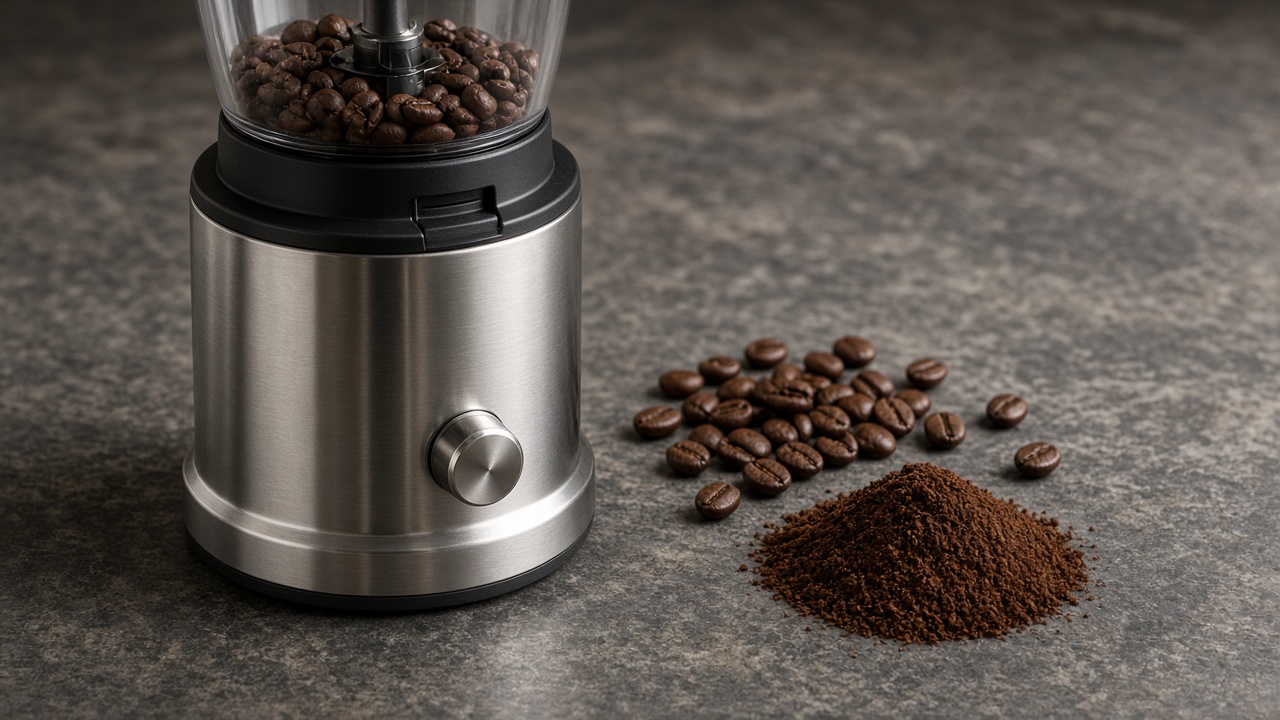
The grinder is the part I underestimated for years, because the machine is the object with the shine and the grinder is the object that makes a noise and a mess. Lavazza's home guide says the opposite, and I think the guide is right. Of the four old Italian words it uses for espresso, macina, the grind, "has more influence on shot quality than the machine itself." A blade grinder chops beans into a random mix of boulders and dust. A burr grinder shears them between two abrasive surfaces and aims at a distribution you can repeat. For espresso, the guide calls a burr grinder the sensible choice, and it tells you to grind immediately before the shot rather than ahead of it. Finer means more resistance, a slower flow, a longer extraction. Coarser means the water finds an easy road and the shot runs short. You start coarser than your pride suggests and walk finer until the cup lands where you asked.
That is the whole review, almost. The rest is what kind of burr, what kind of adjustment, and how much ground coffee the machine is hiding from you.
Baratza's dial-in guide describes the burrs in its own grinders without crowning a winner, which is the tone I want from a manufacturer. Conical burrs, on the Encore ESP, the Virtuoso+, and the Sette series, are described as giving a round, sweet profile, a little more forgiving because of the fine particles in the grind, and lower retention. Flat burrs, on the Vario+, the Vario W+, and the Forté AP, are described as cleaner and more articulate, a good fit for single-origin espresso, with a macro lever and a micro lever so the step between settings can be small. Steel burrs, in the same guide, read as clean and modern and consistent. Ceramic burrs read as round and traditional, and, like the conicals, a bit easier to dial because of the fines they make. Prima's glossary describes the metal without the tasting notes. A conical set is an inner cone inside a ring. Coffee moves from the larger cutting faces at the tip down to the fine faces at the base, and the pair sits upright so gravity can feed it. Flat burrs are two discs face to face. Coffee enters the center hole and leaves at the rim, and the discs may lie horizontal, tilted, or vertical. The heritage SCA definition does not pick a shape. It only requires a grind that lets the shot run 20 to 30 seconds. The sentence Baratza is willing to print, and a shop page often will not, is that no burr is better. They emphasize different things. If you want the test, it is a cup, not a slogan. The guide's working recipe is 18 grams in, 36 grams out, 25 to 32 seconds, dose held still while the grind moves. Sour and fast means finer. Bitter and slow means coarser. Channeling, the guide says, is usually puck preparation, not the grinder, and a bottomless portafilter makes the uneven flow visible.
A trade piece in Fresh Cup, reported by Chris Ryan and updated in 2019 from a 2014 story, puts manufacturers on the record about the same choice. Roberto Bresciani, president of Nuova Simonelli, said the company's grinders use flat burrs because the firm finds that a conical profile produces more fines, and that those fines migrate and can choke the flow. With their flat burrs, he said, the pour rate is more uniform. Jim Piccinich, a partner at 1st-line Equipment, told the magazine he will recommend both shapes and that burr size can matter more than the shape, because larger burrs let you grind longer with less heat in the metal. I am not going to dissolve those two men into a single law of nature. One builder prefers flats because of fines. A dealer thinks diameter and heat deserve the louder vote. Both are allowed to be describing what they have seen. What I take home is that "burr" is not one tool. Flat and conical are different cuts, and a hot burr is a different tool from a cool one.
Heat shows up when the second and third shots drift. Fresh Cup quotes David Schloss saying that in a rush the grinder starts to cook coffee sitting on the burrs, so a later shot can taste worse. Bresciani adds that cold burrs and hot burrs cut differently, so a timed dose in the morning is not the same dose an hour later. If the grinder has been asleep, the first grind is not a verdict. If you have been grinding for guests, taste the cup in front of you.
Retention is the quiet thief. Coffee that stays in the chute is coffee you ground earlier, and earlier is how aroma leaves. Baratza praises the Sette series for low retention and says that makes dialing-in quicker, because what you just adjusted is mostly what lands in the basket. Fresh Cup's account of dosers is the commercial version of the same trouble. A doser grinds into a chamber and portions from it, which is fast on a bar. Piccinich told the magazine that coffee's best flavor is within about seven minutes of grinding, and that after that the grounds degas and the aroma goes. Bresciani noted that some shops pulled the doser off an older grinder and still had a channel of pre-ground coffee inside, so the clump that fell out had been waiting. Purpose-built doserless grinders were the manufacturers' reply: beans in, a short path, grounds into the portafilter for this shot. At home the same idea is smaller. A grinder you cannot empty will serve you yesterday's dust at the start of today's shot. A grinder with a short path will waste less and lie less.
Stepped or stepless is the other spec that sounds like a personality quiz. Baratza's Vario and Forté notes describe a macro adjustment to get close and a micro adjustment to finish, and the guide suggests starting the micro lever in the middle. The Encore ESP is described as a range where small clicks matter, with an espresso band you should enter from the coarse end. Stepless grinders, which this particular guide does not center, let you sit between clicks. I will not claim a stepless collar is always kinder. I will say that espresso is sensitive enough, in Lavazza's account, that a small change in grind moves the shot by seconds, and a grinder that can make a small change is the one that matches the task. A grinder with ten settings from press pot to Turkish, and only one of them anywhere near espresso, will strand you on the wrong side of a click.
Blade grinders remain in drawers because they are cheap and because they look like a complete idea. They are a complete idea for something else. Lavazza is blunt: the particles are inconsistent, and inconsistency is the enemy of a puck that the water is supposed to cross evenly. I am not going to tell you a blade cannot make a pleasant drip coffee on a patient morning. I am going to tell you it is a poor partner for the 18-gram recipe above, because that recipe assumes the resistance of the puck is something you chose. A random chop chooses it for you, again, every time.
If I were standing in a shop with a grinder in my hands, the questions would be these. Are the burrs conical or flat, and does the maker say what that cut tends to taste like, the way Baratza does, instead of calling it professional and stopping? Can I move the setting by a little, or only by a leap? How much coffee stays inside after I grind, and can I get it out? Does the path from burr to basket look short? Will I grind for one cup, or into a bin that waits? And, because Fresh Cup's sources would not let me forget it, what happens to the metal when it gets warm?
None of those questions requires a leaderboard. They require a manual and a cup. The machine can be patient. The grinder has to tell the truth about the size of a particle, this morning, for this coffee, before the water arrives.